
The context treadmill
I've been using Claude Code as a personal OS for my day-to-day and it transformed how I work. I built it a memory, and it gets better every time I interact with it. You just need to take the reins on context management.
This isn't about coding (I use Cursor for that). It's about everything else. The real leverage isn't in getting AI to write things for me. It's in helping me actually think through decisions. Pressure-testing product design, figuring out the approach for a new hire, working through a strategy before I commit to it. I was trying to do this kind of work with ChatGPT, but I was stuck on what I now think of as the context treadmill: every conversation, I'd re-upload files, re-explain what I was working on, re-establish who I was. I'd spend rounds of back-and-forth just to get something generic enough that I'd mostly rework it anyway.
I'd been gravitating toward Claude because the results were better, but I kept going back to ChatGPT because I thought my chat history there was worth something. Then I stumbled into Teresa Torres' Stop Repeating Yourself and it clicked. Since Claude Code runs on your filesystem, you can build your own memory layer. Local text files that both you and Claude can read and work on, project instructions, context about your work, reference material, all of it available every session and improving over time. When Claude knows your work, your team, your constraints, it can go much deeper. It challenges your assumptions with specifics, not surface-level advice. And it compounds, every session builds on the last. That's a huge deal.
It starts with one file
Say I'm working on a new product feature, but I haven't built out the context for that product area yet. With Claude Code, I don't start by prompting. I brain dump everything on my mind using voice mode, and Claude interviews me for anything that's ambiguous or missing. By the end of that session, I have a structured context file that Claude can reference in any future conversation.
To give you a concrete example: I started with a single file describing what my company does. Claude asked follow-up questions about target markets and customer personas, so those became their own files. When I later needed competitive research, that context was already there. And when I had to think through a feature for a specific audience, the persona description work I'd done days earlier made Claude's output significantly sharper. One file snowballed into a product knowledge base that keeps feeding everything I do.
Here's what my setup looks like today. None of this existed a few weeks ago. It all grew organically from just doing the work.
Context that grows over time:
my-vault/
├── Product/
│   ├── product-info.md          - What we do, how it works
│   ├── Product A/
│   │   ├── context.md           - Product area context
│   │   └── feature-prd.md       - PRD for a specific feature
│   └── Product B/
│       ├── context.md
│       └── competitive-research/
├── Team/
│   └── team.md                  - Org structure, roles, dynamics
└── Personal/
    ├── House/
    └── Blog/                    - This blog
These directories don't start this way. They start as a single context file. As the context grows, I ask Claude to split it into separate files, and sometimes it creates a new subdirectory on its own. My Product directory started as one product-info.md. As I worked on different areas, it branched into subdirectories for each product, each with its own context, PRDs, and feature specs.
As I kept doing the same kinds of work repeatedly, I started asking Claude to turn those into reusable commands and skills. I describe what I want in plain English, and Claude builds it. That's how the second part of my setup came together:
my-vault/
├── Competitive Analysis/
│   ├── product-info.md          - Our product context
│   ├── competitors.md           - Who we're tracking
│   └── _claude/                 - Skill that runs the research
├── Stories/                     - Jira story writing skill
└── Tasks/                       - Task management system
Competitive Analysis researches competitors and generates comparison tables from context files I maintain. Stories writes Jira tickets in my format and tone (which are set up to be read by coding agents that implement and open PRs, but that's for another article). Tasks is my task management system. All of these started as one-off sessions with Claude that I turned into reusable workflows.
It's just text files
Everything is markdown, plain text files that both AI and humans read naturally. That's what makes this setup work: me and Claude are literally looking at the same thing. I can read what Claude wrote, edit it directly, and Claude sees my changes in the next session. There's no translation layer, no export, no copy-pasting between tools.
I pair this with Obsidian, which is essentially a local Notion: a nice interface over a folder of markdown files on your computer. It means I can browse my whole vault, review what Claude produced, and make edits myself, all in the same place Claude works from. But Obsidian is optional. Any text editor works.
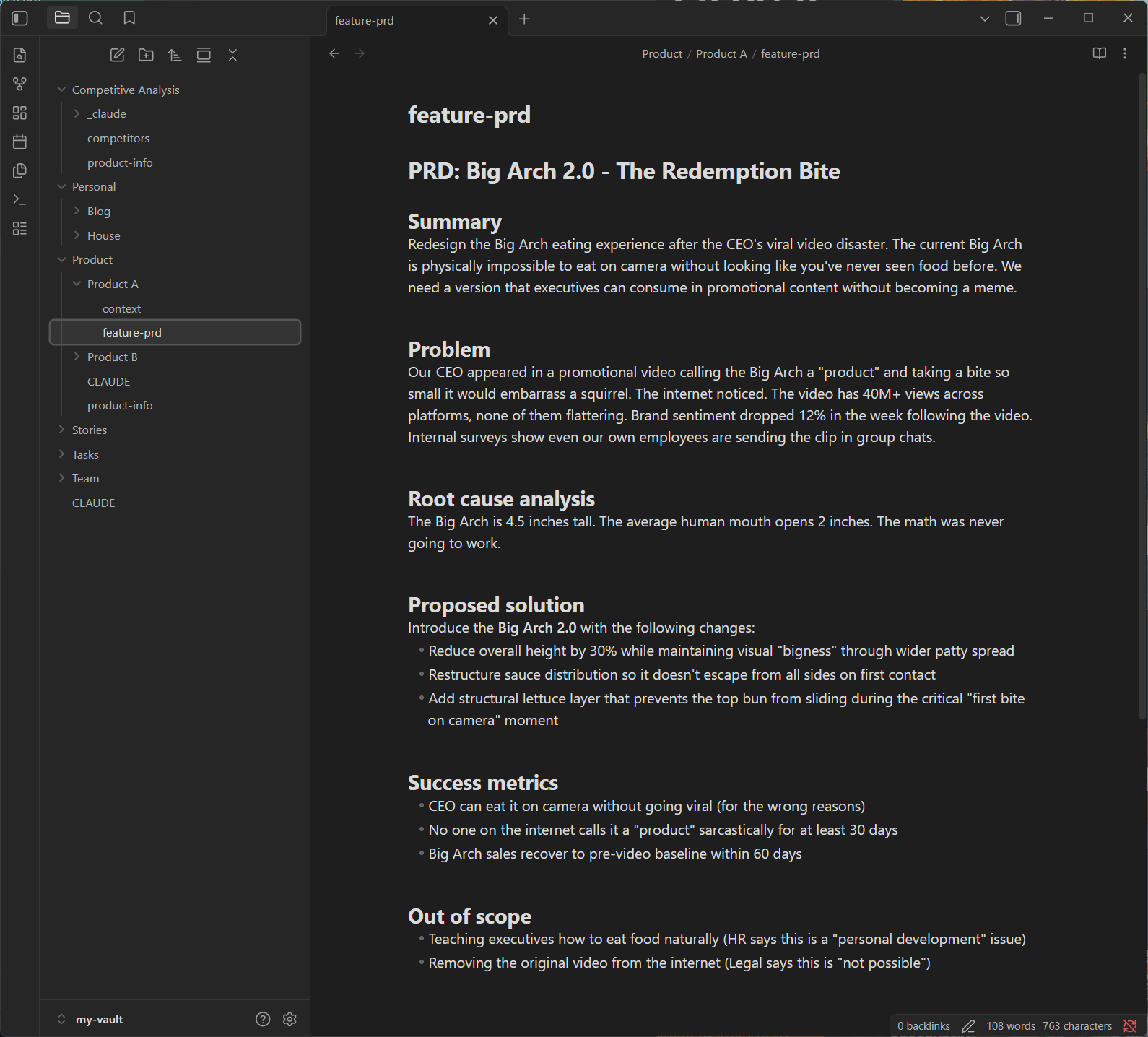
A fake PRD for penguin social media on smart fridges. We surveyed 200 penguins. They all ignored the survey.
And because it's all just files on your computer, you're not locked into anything. If a different model takes the lead tomorrow, you point it at the same folder and keep going.
Try it yourself
These are the articles that got me started. Teresa Torres explains it clearly for non-technical people:
- What is Claude Code and How is it Different? - A clear explanation of what Claude Code is and why it's not just for developers.
- Stop Repeating Yourself: Give Claude Code a Memory - The article that got me started. Walks you through setting up memory and context files.
If you're already comfortable with a terminal, you'll feel right at home. If you're not, don't let it scare you off. You type in plain English, and if you ask, Claude teaches you how to use it.
On cost: Claude Code requires a Pro subscription ($20/month). That's more than enough for everything I've described here. I think even Max is worth it, but start with Pro and see for yourself.
If you've found your own approach to context management with AI for non-coding work, I'd love to hear about it.